Grim’s Ditch, Grim’s Dyke (also Grimsdyke or Grim’s Bank), Devil’s Ditch or Devil’s Dyke
These are the many kind of names you will come across when finding an assortment of Prehistoric earthworks found hidden along the hills and fields of Ingland.
It is debated heavily why these earth works were built and used. What purpose did they serve for their builders? What purpose did it also serve for those long after it’s construction and of course, what purpose do they serve to us?
“The method of building this type of earthwork involved digging a trench and forming the upcast soil into a bank alongside it. This practice has resulted in the name dīc being given to either the trench or the bank, and this evolved into two words, ditch and dyke in modern British English.”
Our first clue into these peculiar ditches is the name, “Grim” now it is believed that this is derived from a Nordic name or title of the god Odin “Grimr“.
It was common for the Anglo Saxons to name features of unexplained or mysterious origin Grim. Odin to the Anglo-Saxons was known as Woden.
Also the name ‘Grim’ is evidence in itself of ancient traditions concerning such structures, which appear to have been ascribed a supernatural origin. Coming from Old English grima, which can mean either ‘goblin, spectre’ or ‘mask’
“If there were any evidence that Wōden was also known among the pagan English as Grim, as he was among the Norsemen, we might conclude that “Grims-Dic” was merely the equivalent of “Wodnes-dic”. The Devil’s Dyke, occasionally met with as the name of ditches, may be compared.“
— W. H. Stevenson, The English Historical Review
Frank Stenton states that there is no direct evidence that Woden was known in England as Grim, but (citing supporting claims by Professor Eilert Ekwall) states that it was very probable. He mentions three sites named Grimes Wrosen: one outside Colchester in Essex; another in Warwickshire on the route of the Roman road Watling Street; and Credenhill in Herefordshire. These earthworks, Stenton asserts, were either considered to have been the supernatural work of Wōden himself, or sites connected strongly with the cult of Wōden where the Anglo-Saxons worshipped the god.
Among Woden’s many roles is that of a god of war, and it may be that the Anglo-Saxons perceived the earthworks as military in function and therefore ascribed them to him. It is also possible that Woden being a god of mysteries or the unknown, these strange constructions may have been attributed to him.
Of course all of this is conjecture and theorizing, but that only adds to the already deep well of mystery that surrounds such things. All of this is very grim in the odinonic sense.
The identities of Wōden and the Devil have also become conflated, as evidenced in the number of earthworks named after the Devil. As the Anglo-Saxon population converted to the new religion of Christianity, baptised converts renounced the old Saxon Gods along with the works of the Devil. It is thought that, as a result of this Christianisation, place names and features once associated with pre-Christian deities then came to be associated with the Devil. The names Grim, Graeme and Graham are closely connected and many British family and place names have been linked with the etymology of Wōden/Grim/Devil: Grimsby (residence of the Devil), Grimsthorpe (Village of the Devil), Grimshaw (the Devil’s Wood), reflected in the use of dragon emblems in heraldry associated with Grim- names.
Earthworks bearing names related to Grim or the Devil proliferate around Britain: Grim’s Ditches exist in Berkshire, Buckinghamshire, Hampshire, Hertfordshire, Oxfordshire and West Yorkshire, and Devil’s Dykes exist in Sussex, Cambridgeshire, Norfolk (near Weeting) and Hertfordshire.
Though only rarely do legends still exist accounting for the earthworks, the exception that proves the rule comes from Hertfordshire, where one of the Grim’s Ditches is said to be the handiwork of the magician Sir Guy de Gravade of Tring Station. Possibly the Revd J. W. Burgess had this in mind when he observed in Records of Buckinghamshire (1858) that the ditch owed its name both to the general superstition concerning the supernatural origins of earthworks and to a belief that only a magician could dig a trench so deep and long. Asserting that Grima was Saxon for a magician, he adds, ‘And with this clue, we may fairly interpret Grimsdyke as the Ditch of the Wizard.’
Again we find the magical connection to these ditches, and of course terms like “Wizard” evoke images of robed men with long beards… who does that remind you of?
“It is a weird or wizard spot, upon its bank nothing of good omen happens. I have been told in perfect good faith, by one who dwelt near it, that on Grimsdyke the unhappy Jane Shore perished, being starved to death by King Richard’s order, a baker also being put to death for his compassion in offering her a penny loaf… That fairies make fun, or make mischief, that ghosts and spectres have peculiar liberty on the soil of the Dyke, is the current belief of the country gossips.“
I believe that Grim Ditches are on the same level of English-Wyrd-Spirt Land spookiness as Ley-Lines, Burial Mounds & Crop circles.
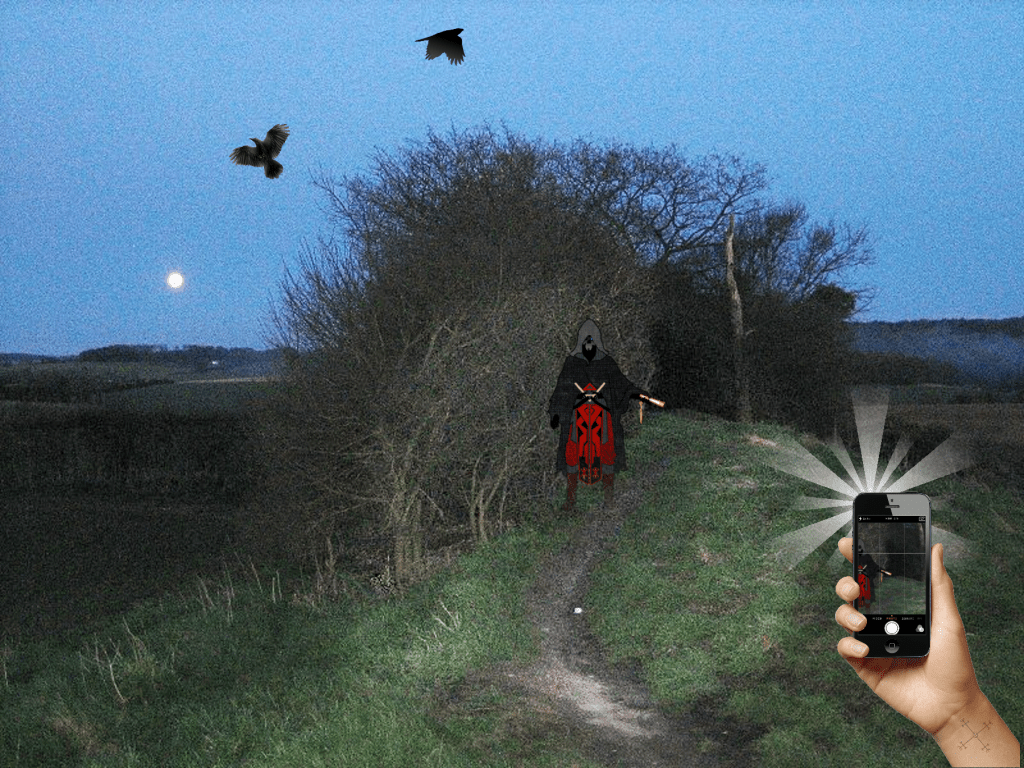
These Ditches are and always will be spiritual hotspots with the persuasion of the wandering god, the one eyed masked one, the cloaked man… Wotan, Woden, Odin, Grim….
This is just the first part of a wider investigation into Grim Dykes.
Stay tuned on my Social media…
 Thoughts of a Hermetic sage
One thought on “Grim’s Ditch”